Orders and shipping
1. When are orders dispatched?
To avoid potentially harmful delays in depots over the weekend, shipments within Italy are dispatched ONLY on Mondays and Wednesdays, excluding public holidays. Orders are dispatched on the first available dispatch day after we receive the order and payment.
Example 1: Order placed and paid for by 11 am on Monday → the parcel is dispatched on Monday, provided all items are available.
Example 2: Order placed and paid for after 11 am on Monday → the parcel is dispatched on Wednesday, provided all items are available.
Example 3: Order placed and paid for after 11 am on Wednesday → the parcel is dispatched the following Monday, five days later, provided all items are available.
International shipments are dispatched on the first available Tuesday that is not a public holiday, after we receive the order and payment.
2. How long does delivery take?
Shipments within Italy leave on Mondays and Wednesdays. Parcels travel by express courier, departing in the evening for delivery the following day, or within 48–72 hours in more remote areas.
International shipments to the countries we serve leave on Tuesdays. Delivery is expected within 48–72 hours.
Please note that the courier is not required to call the recipient before attempting delivery.
3. How much does shipping cost?
Italy:
- €9 for orders up to €24 + VAT;
- €3.99 for orders up to €49 + VAT;
- Free for orders over €49 + VAT.
If you choose scheduled shipping and specify a Monday or Wednesday dispatch date, an additional charge of €0.99 applies.
International:
Euro 1 – Austria, Belgium, France, Germany, Luxembourg, the Netherlands and Spain:
- €12 for orders up to €24 + VAT;
- €8 for orders up to €49 + VAT;
- €3.99 for orders over €49 + VAT.
Euro 2 – Croatia, Denmark, Poland, Portugal, Czechia, Slovakia, Slovenia and Hungary:
- €25 for orders up to €24 + VAT;
- €21 for orders up to €49 + VAT;
- €17 for orders over €49 + VAT.
We do not ship to other countries.
4. How can I pay for my order?
We accept credit cards through Stripe, PayPal, online bank transfers, SEPA direct debit, Apple Pay and Google Pay.
5. When is the best time of year for the kit experience?
For ButterflyKit and MacaKit, the best period is March to September, when temperatures are milder and the butterflies can complete their life cycle in suitable conditions once released.
The Bombyx and Gryllo experiences can take place all year round.
6. What does “activating” the kit mean, and how soon should I do it after delivery?
“Activating” the kit means choosing a suitable location for the Petri dish containing the caterpillars, or for the cricket enclosure. Choose a place with a fairly stable temperature and natural, indirect light, away from draughts.
Activate the kit within 2–3 days of delivery. Gryllo is the exception: activate it as soon as possible, no later than the day after delivery.
7. How can I track my order?
When your parcel is dispatched, you will receive an email or text message with the shipping details and tracking information.
ButterflyKit
1. My caterpillars have arrived. What should I do?
For the first few days, the caterpillars will not need any care.
Read the instructions carefully and choose a suitable place for the Petri dish containing the caterpillars: a fairly stable temperature between 18 and 27 °C, natural indirect light and no draughts.
Three days after arrival, transfer them to the dome and provide fresh food.
2. My caterpillars are not moving! Are they dead?

It is normal for caterpillars to remain still for a while. During moulting, they may stay in the same position without eating for up to 12 hours.
How can I tell whether a caterpillar is moulting? As well as remaining still, it may show a pale band separating the head from the thorax.
3. What is the web-like material the caterpillars produce in the Petri dish?
This is silk produced by the caterpillars to help them grip the walls and move around more easily.
4. How often should I feed the caterpillars?

The caterpillars must always have moist food available. Replace it approximately every two days.
5. When should I remove the caterpillars’ droppings?
Cleaning the caterpillars’ containers to remove droppings is important, especially in humid conditions. However, cleaning too frequently can disturb the caterpillars unnecessarily.
We recommend removing the caterpillars’ droppings when you replace their food, unless excessive moisture or mould develops and makes earlier cleaning necessary.
6. Several days have passed, but my caterpillars are still shorter than 3 cm
If the caterpillars have not reached this length three days after arrival, transfer them to the dome anyway so that you can provide fresh food.
7. A caterpillar has turned completely black! What does this mean?
If a caterpillar is completely black, it is no longer alive. Take a photo anyway, in case you need to contact us for help. Gently remove it from the container.
8. How can I tell when the caterpillars are about to pupate?


After about ten days, depending on temperature, each caterpillar will attach itself to the dome lid, stop feeding and begin its final moult, transforming into a chrysalis.
The photo shows what the caterpillars look like just before this transformation.
Do not touch newly formed chrysalises for at least 3–4 days after pupation.
9. How do I position the chrysalises in the emergence box?

The head must face upwards.
To remove the chrysalises without damaging them, wait four days after they form. You can cut the anchoring silk threads with small manicure scissors. Then place each chrysalis into a pocket of the fabric holder, with its “tail”, the narrower end, pointing downwards. Make sure the upper half protrudes from the pocket so that the emerging butterfly can grip the holder and expand its wings properly. See the accompanying photo for an example.
10. My chrysalises have been still for a month, and no butterflies have emerged!
If the chrysalises formed a month ago and the butterflies have not yet emerged, they may have entered an overwintering state. Changes in temperature and day length can alter the caterpillars’ development.
How can I keep the chrysalises alive?
Recreate the conditions in which the caterpillars developed before pupation. You can place the chrysalises outdoors in a naturally lit spot protected from direct sunlight, water and wind. Alternatively, you can put them in the fridge to simulate suitable outdoor temperatures.
After four months of cold conditions, place them in the emergence box at room temperature. Position them in the fabric holder (the green fabric) so that the butterflies can grip it and expand their wings properly.
11. My chrysalises are moving! Is this normal?
Yes, this is completely normal! It means the chrysalises are alive. The movement is a natural defensive response.
12. What is the black liquid on the chrysalis?
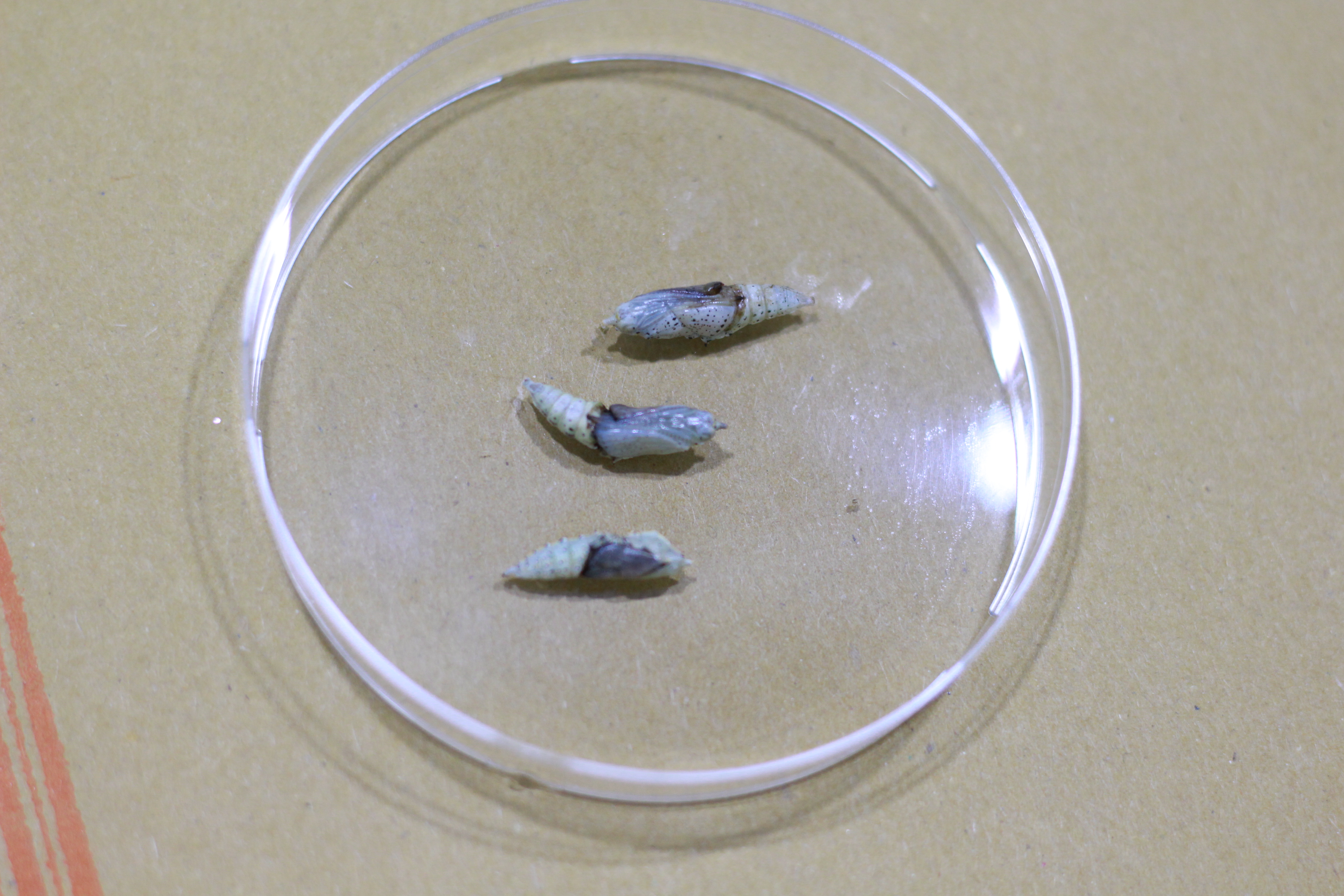
It is haemolymph, the insect’s circulatory fluid. Caterpillars can injure themselves during pupation.
The butterfly may still be able to emerge. Observe the chrysalis for a few days and, if its colour does not change, move it to the emergence box, taking care not to injure it further.
13. My chrysalises are dark! What does this mean?
If they have been dark in colour for some time, they are no longer alive. Sometimes a caterpillar does not complete its development into a butterfly. This is very common.
In the wild, an estimated one caterpillar in 50 survives to adulthood.
14. A butterfly is stuck in its pupal casing. How can I help?
In most cases, this is caused by incorrect positioning in the fabric holder.
If it happens, act immediately to free the butterfly by removing the pupal casing from its body or wings, taking care not to injure it.
Butterflies have only a short window of time (about 10 minutes) during which their wings are flexible and can expand. Their bodies then pump haemolymph into the wings, which dry in the position they have taken.
If the wings remain deformed, we still recommend releasing the butterfly onto a flowering bush, where it can feed and find shelter.
15. Can I release the butterflies if it is raining?
In bad weather, you can postpone releasing the butterflies and keep them in the small box for 1–2 days. Keep them cool (below 18 °C) and in the dark.
16. When is the best time to buy the kit?
The best period for raising Large White butterflies is approximately March to October, depending on temperature. You can also use the kit in winter: the caterpillars will then form overwintering chrysalises, from which butterflies will emerge with the first warm spring weather.
17. Can I use insecticides at home while using the kit?
Any exposure to insecticides, even brief or accidental, could be fatal to the caterpillars, so we advise against using them while raising your insects.
If your pets have been treated with antiparasitic products, remember that caterpillars are extremely sensitive to these substances. Wash your hands thoroughly before handling the caterpillars or working in their containers, to avoid contamination that would kill them.
18. I have lost the instructions!
Lost the instructions and not sure where to find them? You can download them here: Download instructions.
MacaKit
1. My caterpillars have arrived. What should I do?
Relax: the caterpillars will not need any care for the first few days.
Read the instructions carefully and choose a suitable place for the Petri dish containing the caterpillars: a fairly stable temperature between 20 and 30 °C, natural indirect light and no draughts.
Three days after arrival, provide fresh food.
2. My caterpillars are not moving! Are they dead?
Do not worry: it is normal for these caterpillars to remain still. At every larval stage, they move only as much as necessary, mainly to feed. During moulting, they may remain still without eating for up to two days.
3. There is condensation inside the Petri dish…
Some condensation inside the Petri dish is normal at first: it is caused by the temperature difference between the inside and outside of the dish and usually stops once the temperatures equalise. If actual droplets form, open the dish and gently dry it with clean paper. If condensation keeps forming for several days, move the dish to a place with a more stable temperature or away from cold draughts.
4. Several days have passed, but my caterpillars are still shorter than 3 cm

If they have not reached this length three days after arrival, provide fresh food and remove any old food remaining.
The caterpillars can stay in the Petri dish until they reach the specified size, then be transferred to the dome.
The photo shows a fifth-instar caterpillar with the characteristic colour pattern, ready to be transferred to the dome.
5. How often should I feed the caterpillars?
If the caterpillars have not reached 3 cm three days after delivery, provide fresh food. Start with a small amount, as they do not eat much at first, and add more as needed. Add fresh food after about three days, removing any old food remaining. Exact timing is not critical: how long the food lasts and how much the caterpillars eat depend on several factors. What matters is that they always have moist food available, rather than dry or excessively old food. Do not use up all the food at once: it must last until the caterpillars are fully grown.
6. When should I remove the caterpillars’ droppings?
Cleaning the caterpillars’ containers to remove droppings is important, especially in humid conditions. However, cleaning too frequently can disturb the caterpillars unnecessarily.
We recommend removing the caterpillars’ droppings when you replace their food, unless excessive moisture or mould develops and makes earlier cleaning necessary.
7. My caterpillar has orange “horns” I had never noticed before!
Do not worry: this is its osmeterium, a forked defensive organ that the caterpillar everts when threatened or to deter other caterpillars. It gives off a pungent smell similar to fennel.
8. How can I tell whether a caterpillar is dead?
If a caterpillar is visibly shrivelled, deflated and lying on its side, it is most likely no longer alive.
Take a photo anyway, in case you need to contact us for help.
If this happens, gently remove the caterpillar from its container.
9. My caterpillar is still, has become smaller and is attached to the support only by its head and “tail”

This is normal! It is about to undergo its final and most complex moult, transforming into a chrysalis. Look closely and you will see a silk “girdle” it has made to secure itself to the support. Do not disturb caterpillars at this stage.
The photo shows a caterpillar ready to pupate.
If it accidentally detaches from the support, leave it as it is and avoid handling it further.
Do not touch newly formed chrysalises for at least 3–4 days after pupation.
10. How do I position the chrysalises in the emergence box?

Wait four days after pupation before removing the chrysalises, to avoid damaging them. Gently detach them from the dome or toothpicks. Sometimes it is easier to remove the silk pad and girdle together with the chrysalis. Place each chrysalis in a pocket of its holder, with the narrower end downwards. The head must face upwards and the back towards the inside of the box. Make sure the upper half protrudes from the pocket so that the emerging butterfly can grip the holder and expand its wings properly. See the accompanying photo for an example.
11. My chrysalises have been still for a month, and no butterflies have emerged!
If the chrysalises formed a month ago and the butterflies have not yet emerged, they may have entered an overwintering state. Changes in temperature and day length can alter the caterpillars’ development.
How can I keep the chrysalises alive?
Recreate the conditions in which the caterpillars developed before pupation. You can place the chrysalises outdoors in a naturally lit spot protected from direct sunlight, water and wind. Alternatively, you can put them in the fridge to simulate suitable outdoor temperatures.
After four months of cold conditions, place them in the emergence box at room temperature. Position them in the fabric holder so that the butterflies can grip it and expand their wings properly.
12. A butterfly is stuck in its pupal casing. How can I help?
In most cases, this is caused by incorrect positioning in the fabric holder.
If it happens, act immediately to free the butterfly by removing the pupal casing from its body or wings, taking care not to injure it.
Butterflies have only a short window of time (about 10 minutes) during which their wings are flexible and can expand. Their bodies then pump haemolymph into the wings, which dry in the position they have taken.
If the wings remain deformed, we still recommend releasing the butterfly onto a flowering bush, where it can feed and find shelter.
13. Can I release the butterflies if it is raining?
In bad weather, you can postpone releasing the butterflies and keep them in the small box for 1–2 days. Keep them cool (below 18 °C) and in the dark.
14. Can I use insecticides at home while using the kit?
Any exposure to insecticides, even brief or accidental, could be fatal to the caterpillars, so we advise against using them while raising your insects.
If your pets have been treated with antiparasitic products, remember that caterpillars are extremely sensitive to these substances. Wash your hands thoroughly before handling the caterpillars or working in their containers, to avoid contamination that would kill them.
15. I have lost the instructions!
Lost the instructions and not sure where to find them? You can download them here: Download instructions.
Bombyx
1. My silkworms are not moving! Are they dead?
Do not worry: silkworms normally remain still for periods of time, especially during moulting. At this stage, they may remain still without eating for up to two days.
2. There is condensation inside the Petri dish…
Some condensation inside the Petri dish is normal at first: it is caused by the temperature difference between the inside and outside of the dish and usually stops once the temperatures equalise. If actual droplets form, open the dish and gently dry it with clean paper. If condensation keeps forming for several days, move the dish to a place with a more stable temperature or away from cold draughts.
3. When should I transfer the silkworms to the tray?
Until the silkworms have eaten all the food in the Petri dish, they do not need extra food or to be moved.
Check them daily and remove their droppings every other day. Remove any mould that develops. If the food dries out, prepare and provide fresh food.
4. Can I feed mulberry leaves to the silkworms?
In some areas, mulberry trees are so contaminated with heavy metals and pesticides that their leaves can be extremely toxic to silkworms.
If you choose to feed the silkworms mulberry leaves, we cannot guarantee their normal development through to the adult stage, meaning the moth’s emergence from its cocoon.
5. When will the silkworms climb onto the supports to spin their cocoons?
For this “mounting” stage to begin, the silkworms must have reached their fifth larval instar. They usually reach the required size within three weeks.
6. How can I tell whether a moth that has emerged from its cocoon is male or female?
You can distinguish female and male silkmoths by two features:
- Size: females are larger than males.
- Antennae: males have broader antennae than females.
7. Will the moths fly away? Can I release them?
Silkmoths are the result of thousands of years of selective breeding by humans and would not survive in the wild. After emerging from their cocoons, they mate and the females lay eggs. A few days later, once their stored energy has been used up, they naturally reach the end of their life cycle.
8. Help! The silkworm eggs have turned black!
The colour change means that the embryos have developed to an intermediate stage.
Once the eggs have turned blue-grey, they can be placed in the fridge and stored for at least six months.
After being brought back to room temperature, the eggs will hatch in about ten days, allowing you to start a new life cycle.
9. Can I use insecticides at home while using the kit?
Any exposure to insecticides, even brief or accidental, could be fatal to the silkworms, so we advise against using them while raising your insects.
If your pets have been treated with antiparasitic products, remember that silkworms are extremely sensitive to these substances. Wash your hands thoroughly before handling the silkworms or working in their containers, to avoid contamination that would kill them.
10. I have lost the instructions!
Lost the instructions and not sure where to find them? You can download them here: Download instructions.
Gryllo
1. My crickets have arrived. What should I do?
You are ready to set up your kit! To prevent injuries during transfer, put the cardboard transport box in the fridge for about ten minutes. This makes the crickets less restless and easier to move into their new enclosure. If a cricket appears motionless, still place it in the enclosure in a warm location, around 20–25 °C, and watch it for about an hour. You should see it recover within that time.
2. My crickets always stay in their shelter
This is normal at first. They need time to settle in and get used to their new home. As mainly nocturnal insects, they are less active during the day and seek shelter from the light.
3. My crickets are not eating
Crickets use energy very efficiently and need very little food. Their water beads, however, need to be replaced frequently. As mainly nocturnal insects, they usually feed at night.
4. Why do crickets chirp?
Chirping is characteristic of adult males. It is a form of communication between members of the same species, with a variety of different sound frequencies.
As in the wild, they immediately stop chirping if they feel disturbed.
5. Why are my crickets chirping so little?
This is normal at first. Once they are used to their surroundings, they will start chirping regularly.
Their chirping rate depends on ambient temperature: the warmer it is, the more they chirp. Pitch depends on body size: larger crickets produce a lower-pitched sound.
6. How can I tell male crickets from females?
House crickets have a yellowish-brown body and head with black spots and bands and are about 16–21 mm long. Their hindwings are long and extend beyond the much stiffer forewings.
Males and females look very similar, but females have a brownish-black ovipositor about 10–15 mm long, flanked by two appendages.
Males also have shorter forewings than females, with enlarged stridulatory scrapers involved in producing their chirping sound.
All the crickets supplied with the kit are male.
7. Can I add other objects to the enclosure?
Yes, let your imagination run free! You can add decorative materials to Gryllo to arrange it as you like. Always use non-toxic materials. We advise against adding live plants, as they may carry bacteria and be eaten by the crickets.
8. A cricket is not moving. Is it dead?
If a cricket remains motionless, it is very likely no longer alive. Remove it from the enclosure as soon as possible.
9. I will be away for a few days. How can I look after my crickets?
No problem: if you are away for a couple of days, make sure the crickets have enough water and food.
If in doubt, add one extra water bead to keep them adequately hydrated until you return.
10. A cricket has escaped! What should I do?
If a cricket escapes during cleaning or feeding, do not worry: this species is fairly easy to catch.
If you cannot recover it, a single cricket in the house does not pose an infestation problem and is not dangerous to people or other animals.
11. Can I use insecticides at home while using the kit?
Any exposure to insecticides, even brief or accidental, could be fatal to the crickets, so we advise against using them while raising your insects.
If your pets have been treated with antiparasitic products, remember that crickets are extremely sensitive to these substances. Wash your hands thoroughly before handling the crickets or working in their containers, to avoid contamination that would kill them.
12. I have lost the instructions!
Lost the instructions and not sure where to find them? You can download them here: Download instructions.
VanessaKit
1. My caterpillars have arrived. What should I do?
The caterpillars will not need any care until they reach 3 cm in length.
Read the instructions carefully and choose a suitable place for the Petri dish containing the caterpillars: a fairly stable temperature between 18 and 27 °C, natural indirect light and no draughts.
Three days after arrival, transfer them to the dome with fresh food.
2. My caterpillars are not moving! Are they dead?
Do not worry: they are not dead! It is normal for caterpillars to remain still for a while. During moulting, they may remain still without eating for up to 12 hours. How can I tell whether a caterpillar is moulting? As well as remaining still, it may show a pale band separating the head from the thorax.
3. What is the web-like material the caterpillars produce in the Petri dish?
This is silk produced by the caterpillars to help them grip the walls and move around more easily.
4. There is condensation inside the Petri dish…
Some condensation inside the Petri dish is normal at first: it is caused by the temperature difference between the inside and outside of the dish and usually stops once the temperatures equalise. If actual droplets form, open the dish and gently dry it with clean paper. If condensation keeps forming for several days, move the dish to a place with a more stable temperature or away from cold draughts.
5. Several days have passed, but my caterpillars are still shorter than 3 cm
If the caterpillars have not reached this length three days after arrival, transfer them to the dome anyway so that you can provide fresh food.
VanessaKit caterpillars move very quickly. Do not leave them unattended during transfer.
6. How often should I feed the caterpillars?
The caterpillars must always have moist food available. Replace it approximately every other day.
7. When should I remove the caterpillars’ droppings?
Cleaning the caterpillars’ containers to remove droppings is important, especially in humid conditions. However, cleaning too frequently can disturb the caterpillars unnecessarily.
We recommend removing the caterpillars’ droppings when you replace their food, unless excessive moisture or mould develops and makes earlier cleaning necessary.
8. How can I tell whether a caterpillar is dead?
If a caterpillar is visibly shrivelled and lying on its side, it is most likely no longer alive.
Take a photo anyway, in case you need to contact us for help.
If this happens, gently remove the caterpillar from its container.
9. How can I tell when the caterpillars are about to pupate?
After about ten days, depending on temperature, each caterpillar will attach itself to the dome lid, stop feeding and begin its final moult, transforming into a chrysalis.
The chrysalis hangs upside down from a silk pad, attached by microscopic hooks at the rear of its abdomen. Do not touch newly formed chrysalises for at least 2–3 days after pupation.
10. How do I position the chrysalises in the emergence box?
To detach the chrysalises safely, wait three days after they form. Hold each one gently as close to its attachment point as possible and pull to detach it.
You can use small manicure scissors to cut any anchoring silk threads.
Place each chrysalis in a pocket of the fabric holder, with the narrower end, or “tail”, pointing downwards. You can insert it sideways to make this easier. Make sure the upper half protrudes from the pocket.
11. My chrysalises are moving! Is this normal?
Yes, this is completely normal! It means the chrysalises are alive. The movement is a natural defensive response.
12. What is the black liquid on the chrysalis?
It is haemolymph, the insect’s circulatory fluid. Caterpillars can injure themselves during pupation.
The butterfly may still be able to emerge, so move the chrysalis to the emergence box anyway, taking care not to injure it further.
13. My butterfly has released a red liquid. Is this normal?
Do not worry: it is not blood! After emerging from the chrysalis, butterflies release a red liquid called meconium, which contains waste products accumulated during the pupal stage.
14. A butterfly is stuck in its pupal casing. How can I help?
In most cases, this is caused by incorrect positioning in the fabric holder (see question 10 or step 4 of the instructions).
If it happens, act immediately to free the butterfly by removing the pupal casing from its body or wings, taking care not to injure it.
Butterflies have only a short window of time (about 10 minutes) during which their wings are flexible and can expand. Their bodies then pump haemolymph into the wings, which dry in the position they have taken.
If the wings remain deformed, we still recommend releasing the butterfly onto a flowering bush, where it can feed and find shelter.
15. Can I release the butterflies if it is raining?
In bad weather, you can postpone releasing the butterflies and keep them in the small box for 1–2 days. Keep them cool (below 18 °C) and in the dark.
16. Can I use insecticides at home while using the kit?
Any exposure to insecticides, even brief or accidental, could be fatal to the caterpillars, so we advise against using them while raising your insects.
If your pets have been treated with antiparasitic products, remember that caterpillars are extremely sensitive to these substances. Wash your hands thoroughly before handling the caterpillars or working in their containers, to avoid contamination that would kill them.
Display prices in:EUR