Orders and Shipping
1- When are shipments made?
To avoid possible and harmful storage during the weekend, national shipments are made EXCLUSIVELY on non-holiday Mondays and Wednesdays and take place on the first working day after receipt of the order and the relative payment.
Example 1: Order placed (and paid) by 11.00 on Monday --> the package leaves (if all the goods are available) on Monday
Example 2: Order placed (and paid) on Monday after 11.00 --> The package leaves (if all the goods are available) on Wednesday.
Example 3: Order placed (and paid) on Wednesday after 11.00 am --> The package leaves (if all the goods are available) on Monday of the following week (5 days later).
Shipments abroad instead take place on the first working Tuesday after receiving the order and the relative payment.
2- What are the delivery times?
National shipments depart on Mondays and Wednesdays . The package will be transported by fast express courier and will leave in the evening to be at its destination the following day (or at most in 48/72 hours, in the most remote areas).
Foreign shipments (in available countries) instead take place on Tuesday . Delivery is expected in 48/72 hours.
We inform you that the courier is not required to notify the recipient by telephone of his passage.
3- What are the shipping costs?
Italy :
- €9 for orders up to €24 + VAT;
- €3.99 for orders up to €49 + VAT;
- Free for orders over €49 + VAT.
If you choose the Scheduled Shipping option (specifying the desired day for departure between Monday or Wednesday), an additional cost of €0.99 will be charged.
Abroad :
Euro 1 - Austria, Belgium, France, Germany, Luxembourg, Netherlands, Spain:
- €12 for orders up to €24 + VAT;
- €8 for orders up to €49 + VAT;
- €3.99 for orders over €49 + VAT.
Euro 2 - Croatia, Denmark, Poland, Portugal, Czech Republic, Slovakia, Slovenia, Hungary:
- €25 for orders up to €24 + VAT;
- €21 for orders up to €49 + VAT;
- €17 for orders over €49 + VAT.
No shipments are expected to other countries.
4- How can I pay for my order?
The accepted payment methods are by Credit Card (through the Stripe platform), PayPal, online bank transfer, SEPA debit, ApplePay, GooglePay.
5- What is the best time to enjoy the experience?
For the ButterflyKit and the MacaKit the best period is certainly from March to September, when the temperatures are milder and the butterflies, once released, have the opportunity to complete their life cycle in a favorable environment.
With Bombyx and Gryllo , however, the experience can be enjoyed all year round.
6- What does "activate" the Kit mean? Once received, how long does it take to activate?
"Activating" the kit means choosing a suitable place to place the petri dish containing the caterpillars (or the case with the crickets). Correct positioning implies a fairly stable temperature, presence of natural but not direct light, away from drafts.
The Kit must be activated within 2-3 days of receipt, with the exception of Gryllo which must be activated as soon as possible (within the day following receipt).
7- How can I track my order?
When your package leaves, you will receive information about the shipment and how to track it via email or SMS.
ButterflyKit
1- The caterpillars have arrived, what should I do?
For a few days the caterpillars will not require any care.
Read the instructions carefully and choose a suitable place to place the petri dish containing the caterpillars (fairly stable temperature, between 18 and 27°C, indirect natural light, away from drafts).
After 3 days from their arrival, it will still be appropriate to transfer them to the dome and give them the new food.
2- The caterpillars aren't moving! Are they dead?

It is normal for caterpillars to spend periods of time still; when they are moulting they may remain in the same position without eating for up to 12 hours.
How do I know if a caterpillar is molting? In addition to immobility, another characteristic is the presence of a light band that separates the head from the thorax.
3- What is that kind of spider web that caterpillars form in the petri dish?
This is silk produced by caterpillars to have greater adhesion to the walls, thus allowing them to move better.
4- How often should I feed the caterpillars?

Caterpillars must always have wet food available which should be replaced approximately every 2 days.
5- When should I remove stool?
Cleaning the containers from excrement is quite important especially in high humidity conditions. However, it should not be done too frequently as it risks causing excessive disturbance to the caterpillars.
We therefore recommend cleaning the containers from faeces at the same time as replacing the food unless excessive humidity and mould have formed.
6- My caterpillars are not 3 cm long and it's been several days already
If after 3 days from their arrival the caterpillars have not yet reached this length, it will be a good idea to transfer them to the dome anyway to provide them with the new food.
7- A caterpillar is all black! What does that mean?
If the caterpillar is completely black, it means that it is no longer viable. We recommend that you take a photo anyway, to use in case you need assistance. In this case, we recommend that you gently remove it from the container in which it is located.
8- When do I understand that caterpillars are forming chrysalises?
After about ten days (depending on the temperatures) the caterpillar will attach itself to the lid of the dome, stop feeding and begin the final moult that will lead it to transform into a chrysalis.
This is what caterpillars look like as they are about to complete their final metamorphosis:

Newly formed pupae should not be touched for at least 3-4 days after their formation.

9- How do I put the pupae in the hatching box?
The important thing is that the head is facing upwards.
To remove the chrysalises without causing damage, simply wait 4 days after they form. To detach them, you can cut the anchoring silk threads with manicure scissors. Then, insert them into the "cartridge" with the "tail" (the narrowest part) facing down. Make sure that the upper half of the chrysalis protrudes from the pockets so that, when emerging, the butterflies can cling to the support and spread their wings correctly. See the photo below as an example:

10- My chrysalises have been dormant for a month and have not yet become butterflies!
If the pupae were formed a month ago and have not yet emerged, it may be that they have developed a winter attitude. The variability of temperatures and the alternation of photoperiods can induce the caterpillars to develop differently.
What to do to keep them alive?
It is important to recreate the climate with which the caterpillar regulated its metamorphosis; they can be placed outside in a naturally lit place but protected from the sun, water and wind. Alternatively, it is possible to place the chrysalises in the refrigerator simulating the ideal external temperature.
After 4 months of cold, place them inside the hatching house at room temperature. It is important that they are placed inside the support (green fabric) so as to allow the butterflies to cling and spread their wings correctly.
11- My pupae are moving! Is this normal?
This is absolutely normal! It means that the pupae are alive, the movement is a natural defense reaction.
12- What is that black liquid on the chrysalis?
This is hemolymph. When the caterpillars form the chrysalis they risk injury.
This does not mean that they cannot emerge, so observe the chrysalis for a few days and if the colour does not change, move it to the emergence box, being careful not to hurt it further.
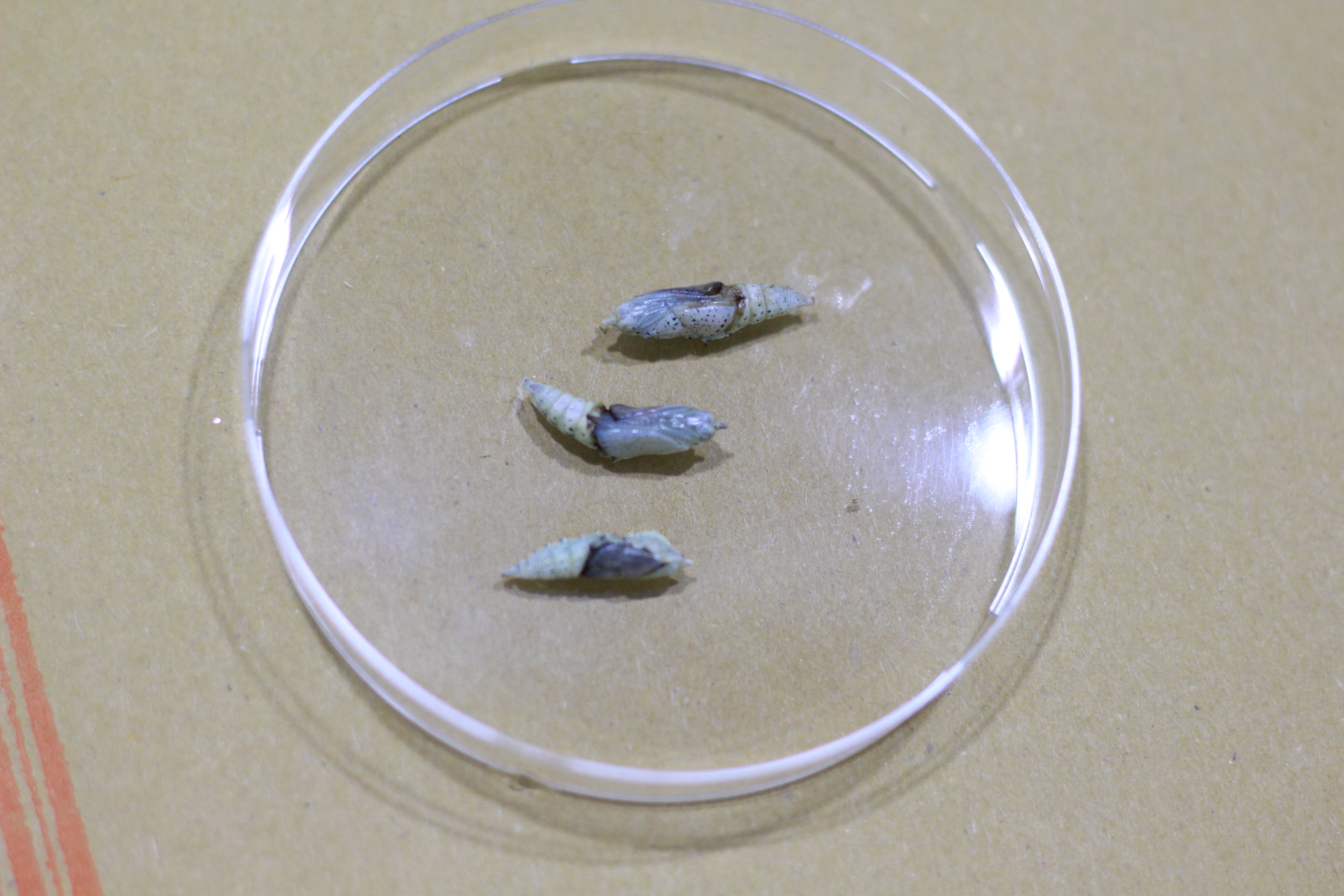
13- My pupae are yellow! What does it mean?
If they have been dark for a while, it means that they are not viable. Sometimes it happens that the caterpillar is unable to complete its life cycle until the butterfly stage. This is a very common phenomenon.
In nature, in fact, the survival rate is estimated at 1 caterpillar in 50.
14 - The butterfly got stuck in the chrysalis, how can I help it?
In most cases this is caused by incorrect positioning within the fabric carrier.
If this happens, you will need to intervene immediately to free it by removing the chrysalis from its body or wings, being careful not to damage it.
Butterflies have a very limited time (about 10 minutes) in which their wings are elastic and can be stretched, then their body will begin to pump hemolymph and they will dry in the position they previously assumed.
If the wings remain deformed, we still recommend that you release the butterfly on a flowering bush, where it can feed and find shelter.
15- If it rains can I release the butterflies?
In case of bad weather, it is possible to postpone the release of the butterflies, which can remain in the box for 1-2 days. The important thing is that they are kept cool (T<18°) and in the dark.
16- What is the best time to buy the kit?
The best period for breeding the Greater Cabbage White is approximately from March to October, depending on the temperatures. However, it is possible to conduct the experiment also in winter, in which case the caterpillars will produce a winter chrysalis that will emerge with the first warm days of spring.
17- Can I use insecticides at home during the experience with the kit?
Any exposure, even if brief and casual, to insecticide products could be fatal for caterpillars, so we advise against using them during breeding. If you have pets treated with pesticides, it is important to know that caterpillars are extremely sensitive to these products, so it is recommended to wash your hands thoroughly before undertaking any operation on the caterpillars in order to avoid contamination that would certainly cause their death.
18- I lost the instructions!
Have you lost the instructions and don't know where to find them? You can download them at this link: Download Instructions .
MacaKit
1- The caterpillars have arrived, what should I do?
Relax... for a few days the caterpillars will not require any care.
Read the instructions carefully and choose a suitable place to place the petri dish containing the caterpillars (fairly stable temperature, between 20 and 30°C, indirect natural light, away from drafts).
After 3 days from their arrival, it will still be appropriate to give them the new food.
2- The caterpillars aren't moving! Are they dead?
Don't worry, it's normal for caterpillars to be immobile, in all stages they only move when strictly necessary. Their only purpose is to feed themselves, so they will only move to satisfy that need. When they are moulting, they could remain still without eating for up to 2 days.
3- There is condensation inside the capsule...
Initially, condensation will form inside the Petri dish: it is due to the difference in temperature between the inside and outside of the dish, and usually once these are balanced it will no longer appear. If actual drops form, it will be a good idea to open the dish and dry it delicately with clean paper. If condensation continues to form for several days, it will be necessary to move the dish to a place with a more stable temperature or away from cold air currents.
4- My caterpillars are not 3 cm long and it's been several days already
If after 3 days from arrival the caterpillars have not yet reached this length, it will be appropriate to administer the new feed, removing any residues of the old one.
The caterpillars can remain in the petri dish and be transferred to the dome when they have reached the indicated size.
Below is an image of a caterpillar with the typical 5th instar coloration that can be transferred to the dome.

5- How often should I feed the caterpillars?
If after 3 days from receiving the caterpillars have not reached a length of 3 cm, it will be appropriate to administer the new food. It is advisable not to overdo the dose (initially they do not eat much) rather you can add more when necessary. It is advisable to add fresh food after about 3 days, removing the residues of the old one. Even in this case the timing is not essential (the duration of the food and the hunger of the caterpillars depends on many factors), the important thing is that the caterpillars always have access to moist food and not dry (or excessively old). Be careful not to waste all the food immediately, it will have to be enough for them until they are fully developed.
6- When should I remove stool?
Cleaning the containers from excrement is quite important especially in high humidity conditions. However, it should not be done too frequently as it risks causing excessive disturbance to the caterpillars.
We therefore recommend cleaning the containers from faeces at the same time as replacing the food unless excessive humidity and mould have formed.
7- The caterpillar has orange horns that I had never noticed!
Don't worry... they are its osmeteria , defense organs that it protrudes in case of danger or to keep other caterpillars away. You will notice that these give off a pungent odor, like fennel.
8 - How do I know if a caterpillar is dead?
If the caterpillar appears visibly wrinkled, hollowed out and positioned on its side, it most likely means that it is no longer viable.
We recommend that you take a photo anyway, to use in case you need assistance.
In this case we recommend gently removing it from the container in which it is located.
9- The caterpillar is immobile, it has shrunk in size and remains attached to the support only with its head and "tail"
No problem! It is about to complete its last moult, the most complicated one, the one that will transform it into a chrysalis . If you pay attention you will notice that, using self-produced silk, it has attached itself to the support with a "belt". Even in this case the caterpillars must absolutely not be disturbed.
This is what a caterpillar ready to transform into a chrysalis looks like:

If it accidentally comes off the support, it is best to leave it as it is and not manipulate it further.
Newly formed pupae should not be touched for at least 3-4 days after their formation.
10- How do I put the pupae in the hatching box?
To remove the pupa without causing damage, simply wait 4 days after they form. Gently detach the pupa from the dome or toothpicks (sometimes it is more effective to remove the cushion and the silk belt with which it is anchored to the substrate together with the pupa). Then insert each pupa into the pocket of its own support, placing the narrowest part downwards. The important thing is that the head is facing upwards and the back towards the inside of the box. Make sure that the upper half of the pupa protrudes from the pockets so that, when emerging, the butterflies can cling to the support and spread their wings correctly. See the photo below as an example:

11- My chrysalises have been dormant for a month and they haven't become butterflies yet!
If the pupae were formed a month ago and have not yet emerged, it may be that they have developed a winter attitude. The variability of temperatures and the alternation of photoperiods can induce the caterpillars to develop differently.
What to do to keep them alive?
It is important to recreate the climate with which the caterpillar regulated its metamorphosis; they can be placed outside in a naturally lit place but protected from the sun, water and wind. Alternatively, it is possible to place the chrysalises in the refrigerator simulating the ideal external temperature.
After 4 months of cold, place them inside the hatching house at room temperature. It is important that they are placed inside the fabric support so as to allow the butterflies to cling and spread their wings correctly.
12- The butterfly got stuck in the chrysalis, how can I help it?
In most cases this is caused by incorrect positioning inside the fabric holder.
If this happens, you will need to intervene immediately to free it by removing the chrysalis from its body or wings, being careful not to damage it.
Butterflies have a very limited time (about 10 minutes) in which their wings are elastic and can be stretched, then their body will begin to pump hemolymph and they will dry in the position they previously assumed.
If the wings remain deformed, we still recommend that you release the butterfly on a flowering bush, where it can feed and find shelter.
13 - If it rains can I release the butterflies?
In case of bad weather, it is possible to postpone the release of the butterflies, which can remain in the box for 1-2 days. The important thing is that they are kept cool (T<18°) and in the dark.
14 - Can I use insecticides at home during the experience with the kit?
Any exposure, even if brief and casual, to insecticide products could be fatal for caterpillars, so we advise against using them during breeding.
If you have pets treated with pesticides, it is important to know that caterpillars are extremely sensitive to these products, so it is recommended to wash your hands thoroughly before undertaking any operation on the caterpillars in order to avoid contamination that would certainly cause their death.
If you have pets treated with pesticides, it is important to know that caterpillars are extremely sensitive to these products, so it is recommended to wash your hands thoroughly before undertaking any operation on the caterpillars in order to avoid contamination that would certainly cause their death.
15- I lost the instructions!
Have you lost the instructions and don't know where to find them? You can download them at this link: Download Instructions .
Bombyx
1- The silkworms are still! Are they dead?
Don't worry, it's normal for silkworms to spend some time still, especially when they are moulting. At this stage they could remain still without eating for up to 2 days.
2- There is condensation inside the capsule...
Initially, condensation will form inside the Petri dish: it is due to the difference in temperature between the inside and outside of the dish, and usually once these are balanced it will no longer appear. If actual drops form, it will be a good idea to open the dish and dry it delicately with clean paper. If condensation continues to form for several days, it will be necessary to move the dish to a place with a more stable temperature or away from cold air currents.
3 - After how long should I transfer the silkworms to the tray?
Until the silkworms have consumed all the feed in the petri dish, they will not need to add any more food or be transferred.
Check them daily and remove the feces every other day. If mold forms, it will be necessary to remove it and if the food becomes dry, it will be necessary to prepare and administer the new food.
4- Can I give mulberry to silkworms?
In some areas, mulberry trees are so polluted with heavy metals and pesticides that they can be extremely toxic to silkworms.
We do not prohibit feeding silkworms with mulberry, but if the experience is not positive and complete until hatching, we do not assume responsibility for what happened.
5- How long do I have to wait for the "climb to the forest"?
In order for the climb to the forest to occur, the silkworms must have reached the Vth stage. They usually reach the right size within 3 weeks.
6- How do I know if the moth that has emerged from the cocoon is male or female?
The female silkworm can be recognized by two differences:
- size: the female specimen is larger than the male
- the antennae: those of the male are wider than those of the female
7- Do butterflies fly away? Can I release them?
Silkworm moths are the result of thousands of years of human selection and would not be able to survive in nature. Once they emerge from the cocoon, the moths reproduce and the females lay eggs. After a few days, once their energy reserves are exhausted, they will naturally end their life cycle.
8- Help, the silkworm eggs have turned black!
The change in color is due to the fact that the embryo has developed to an intermediate stage.
Once the eggs have taken on a blue-grey colour they can be placed in the fridge and kept for at least six months.
Once brought back to room temperature the eggs will hatch in about ten days and it will be possible to start a new cycle ...
9- Can I use insecticides at home during the experience with the kit?
Any exposure, even if brief and casual, to insecticide products could be fatal for silkworms, so we advise against using them during breeding.
If you have pets treated with pesticides, it is important to know that caterpillars are extremely sensitive to these products, so it is recommended to wash your hands thoroughly before undertaking any operation on silkworms in order to avoid contamination that would certainly cause their death.
10- I lost the instructions!
Have you lost the instructions and don't know where to find them? You can download them at this link: Download Instructions .
Gryllo
1- The crickets have arrived, what should I do?
You are ready to activate your kit! To prevent the crickets from getting hurt during the transfer, we recommend placing the cardboard case in the fridge for about ten minutes. This way the crickets will be less restless and it will be easier to transfer them into their new home.
If a specimen appears immobile, place it in the warm tank (around 20-25°) and monitor it for about an hour. Within this time you should notice a recovery.
If a specimen appears immobile, place it in the warm tank (around 20-25°) and monitor it for about an hour. Within this time you should notice a recovery.
2- Crickets always stay in the house
At first it is normal, they need to settle in and need some time to become familiar with what will be their new home. Having nocturnal habits, they will be less active during the day as they will seek shelter from the light.
3- Crickets don't eat
They are very energy efficient specimens and therefore require very little food (unlike water pearls which will need to be replaced frequently). They usually feed at night having mainly nocturnal habits.
4- Why do crickets sing?
Singing is a prerogative of adult male specimens and is a type of intraspecific communication between specimens that produce a multitude of different sound frequencies.
As in nature, if they feel disturbed they immediately stop singing.
5- Why don't crickets sing much?
It's normal at first, once they've gotten used to their surroundings they'll start singing regularly.
The frequency of the songs is proportional to the ambient temperature, the warmer it is, the more the cricket sings. The tone, however, varies according to the size of the specimen, the larger its size, the more serious the tone will be.
6- How can I distinguish male specimens from females?
In the house cricket, the body and head are yellowish-brown with black spots and bands and the size is around 16-21 millimetres. The hind wings are very long and protrude from the front wings, which are clearly more rigid.
Males and females are very similar, but females have a brown-black ovipositor of about 10-15 mm surrounded by two appendages.
In addition, the forewings of males are shorter than those of females and the scrapers are enlarged to better reproduce the song.
The crickets in the kit are all male.
7- Can I add other items inside the box?
Of course, unleash your imagination! You can insert other furnishing materials inside Gryllo to decorate it as you like! Always use non-toxic materials. We also advise against placing real plants as they can carry bacteria and be ingested by crickets.
8- A cricket doesn't move, is it dead?
If a cricket is immobile, it is most likely no longer viable, in which case remove it from the tank as soon as possible.
9- I have to be away from home for a few days, how can I manage my crickets?
No problem! If you have to go away for a couple of days, it will be enough for the crickets to have enough water and food.
If in doubt, give him an extra pearl of water, to ensure he is well hydrated until you return.
10- A cricket has escaped, what do I do?
If a cricket should escape from its box during cleaning or feeding operations, do not worry, this species is quite easy to recover.
If recovery is not possible, the presence of a single specimen in the house is not a problem in terms of infestation, furthermore it is not dangerous for humans or other animals.
11- Can I use insecticides at home during the experience with the kit?
Any exposure, even brief and casual, to insecticides could be fatal to crickets, so we do not recommend their use during breeding.
If you have pets treated with pesticides, it is important to know that crickets are extremely sensitive to these products, so it is recommended to wash your hands thoroughly before undertaking any operation on the crickets in order to avoid contamination that would certainly cause their death.
12- I lost the instructions!
Have you lost the instructions and don't know where to find them? You can download them at this link: Download instructions .
VanessaKit
1-The caterpillars have arrived, what should I do?
The caterpillars will not require any care until they reach 3 cm in length.
Read the instructions carefully and choose a suitable place to place the petri dish containing the caterpillars (fairly stable temperature, between 18 and 27°C, indirect natural light, away from drafts).
After 3 days from their arrival, it will still be appropriate to transfer them to the dome with the new food.
2 - The caterpillars aren't moving! Are they dead?
Don't worry, they're not dead! It's normal for caterpillars to spend periods of time still, when they are moulting, they could remain still without eating for up to 12 hours. How do I know that a caterpillar is moulting? In addition to immobility, another characteristic is the presence of a light band that separates the head from the thorax.
3 - What is that kind of spider web that caterpillars form in the petri dish?
This is silk produced by caterpillars to have greater adhesion to the walls, thus allowing them to move better.
4 - There is condensation inside the petri...
Initially, condensation will form inside the Petri dish: it is due to the difference in temperature between the inside and outside of the dish, and usually once these are balanced it will no longer appear. If actual drops form, it will be a good idea to open the dish and dry it delicately with clean paper. If condensation continues to form for several days, the dish will need to be moved to a place with a more stable temperature or away from cold air currents.
5 - My caterpillars are not 3 cm long and it's been several days already
If after 3 days from their arrival the caterpillars have not yet reached this length, it will be a good idea to transfer them to the dome anyway to provide them with the new food.
Vanessa caterpillars move very quickly, during the transfer it is best not to leave them unattended.
6 - How often should I feed the caterpillars?
Caterpillars must always have wet food available, which should be replaced approximately every other day.
7 - When should I remove stool?
Cleaning the containers from excrement is quite important especially in high humidity conditions. However, it should not be done too frequently as it risks causing excessive disturbance to the caterpillars.
We therefore recommend cleaning the containers from faeces at the same time as replacing the food unless excessive humidity and mould have formed.
8 - How do I know if a caterpillar is dead?
If the caterpillar appears visibly wrinkled and positioned on its side, it most likely means that it is no longer viable.
We recommend that you take a photo anyway, to use in case you need assistance.
In this case we recommend gently removing it from the container in which it is located.
9 - When do I understand that caterpillars are forming chrysalises?
After about ten days (depending on the temperatures) the caterpillar will attach itself to the lid of the dome, stop feeding and begin the final moult that will lead it to transform into a chrysalis.
This will be suspended upside down from a silk pad by microscopic hooks on the back of the abdomen. Newly formed pupae should not be touched for at least 2-3 days after they form.
10 - How do I put the pupae in the hatching box?
To properly detach the pupae (after 3 days from their formation), simply pull them by gently grabbing them as close as possible to the anchoring point.
You can help yourself by cutting any anchoring silk threads with manicure scissors.
Insert the chrysalises into the “cartridge” with the narrowest part (the tail) facing down. To make insertion easier, you can insert them sideways, making sure that the upper half of the chrysalis protrudes from the pockets.
11 - My pupae are moving! Is this normal?
This is absolutely normal! It means that the pupae are alive, the movement is a natural defense reaction.
12 - What is that black liquid on the chrysalis?
This is hemolymph. When the caterpillars form the chrysalis they risk injury.
This doesn't mean they won't be able to hatch, so move them to the hatching box anyway, being careful not to hurt them further.
13 - The butterfly released a red liquid, is this normal?
Don't worry, it's not blood! Once the butterfly has hatched, it will release a red liquid substance, which is meconium, a liquid that contains waste products accumulated in the chrysalis stage.
14 - The butterfly got stuck in the chrysalis, how can I help it?
In most cases this is caused by incorrect positioning inside the fabric holder (see question 10 or point 4 of the instructions).
If this happens, you will need to intervene immediately to free it by removing the chrysalis from its body or wings, being careful not to damage it.
Butterflies have a very limited time (about 10 minutes) in which their wings are elastic and can be stretched, then their body will begin to pump hemolymph and they will dry in the position they previously assumed.
If the wings remain deformed, we still recommend that you release the butterfly on a flowering bush, where it can feed and find shelter.
15 - If it rains can I release the butterflies?
In case of bad weather, it is possible to postpone the release of the butterflies, which can remain in the box for 1-2 days. The important thing is that they are kept cool (T<18°) and in the dark.
16 - Can I use insecticides at home during the experience with the kit?
Any exposure, even brief and casual, to insecticides could be fatal to caterpillars, so we do not recommend their use during breeding.
If you have pets treated with pesticides, it is important to know that caterpillars are extremely sensitive to these products, so it is recommended to wash your hands thoroughly before undertaking any operation on the caterpillars in order to avoid contamination that would certainly cause their death.
Display prices in:EUR